The logo on a hockey bag has to survive everything the bag survives: soaked gear, locker-room floors, the belly of a team bus, and a full season of being dragged across parking lots. That makes decoration a durability decision as much as a branding one. Pick the wrong method and the crest cracks or peels by playoffs; pick the right one and it still looks sharp after sixty games. Three approaches cover almost every custom hockey bag order — embroidery, screen printing, and heat-applied transfers such as DTF — and each one wins in a different situation.
Start with the fabric, because it limits your options
Hockey bags are almost always built from coated woven polyester or nylon, rated by denier (the D number). 600D polyester is the workhorse for team bags: it weighs roughly 6.5 to 8.0 ounces per square yard and, in published abrasion testing, endures on the order of 9,000 rub cycles before meaningful wear. Step up to 1000D ballistic nylon and abrasion resistance climbs past 15,000 cycles, at a fabric-cost premium of about 15 to 30 percent and noticeably more weight. The weave matters as much as the number: a dense 2×2 ballistic basket weave outlasts a plain weave at the same denier. This matters for decoration because thick, coated, textured panels take stitches and heat transfers well but can fight screen-print ink adhesion, and any decoration is only as durable as the panel it sits on.
Embroidery: the most durable, within real limits
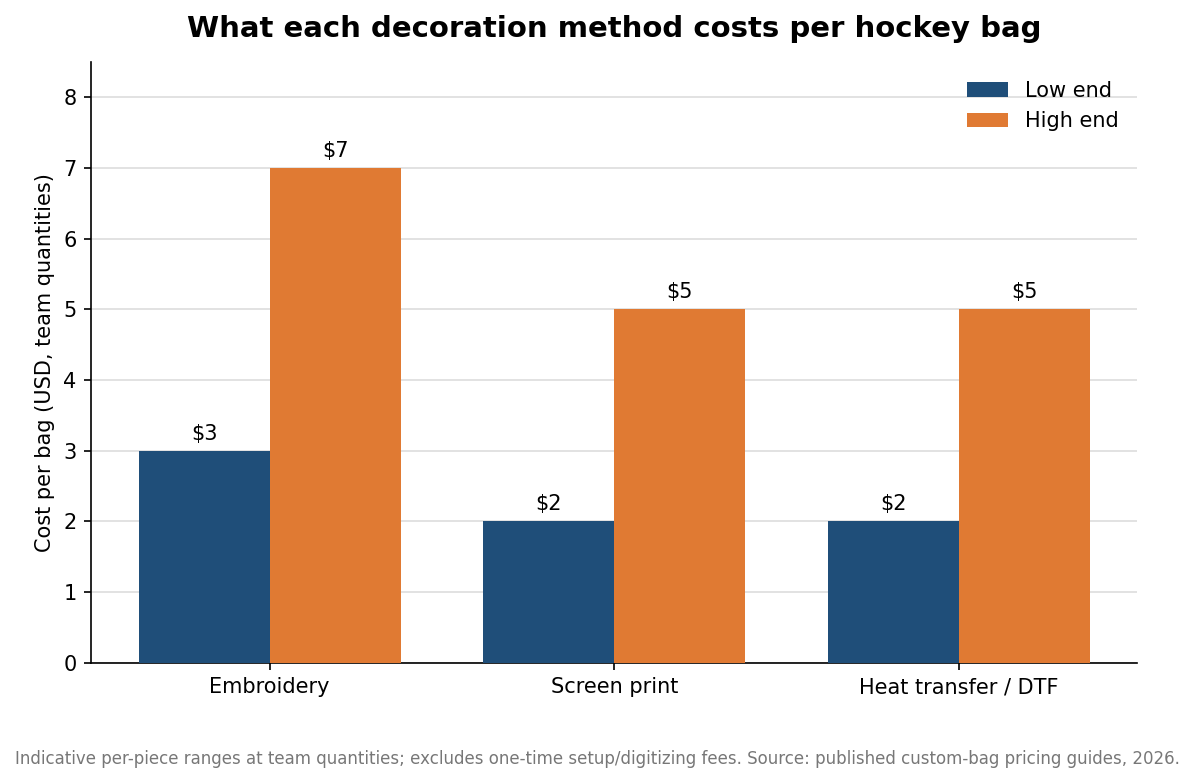
Thread does not fade, crack, or peel, which is why embroidery is the most durable way to brand a bag and the default for team gear that will be abused for years. Polyester embroidery thread resists UV and abrasion, and a stitched logo reads as premium up close. Expect roughly $3 to $7 per bag at team quantities, plus a one-time digitizing fee — commonly $20 to $80 — to convert your artwork into a stitch file. The trade-offs are detail and color. Fine gradients, photographic images, and text under about a quarter inch do not reproduce cleanly, and cost scales with thread colors and stitch count: a bold left-panel logo might run 8,000 to 12,000 stitches, while a dense full-panel design can climb past 30,000. Keep embroidered artwork to solid shapes and a handful of thread colors and it will both look better and cost less.
Screen printing: cheapest per piece at volume, if the art is simple
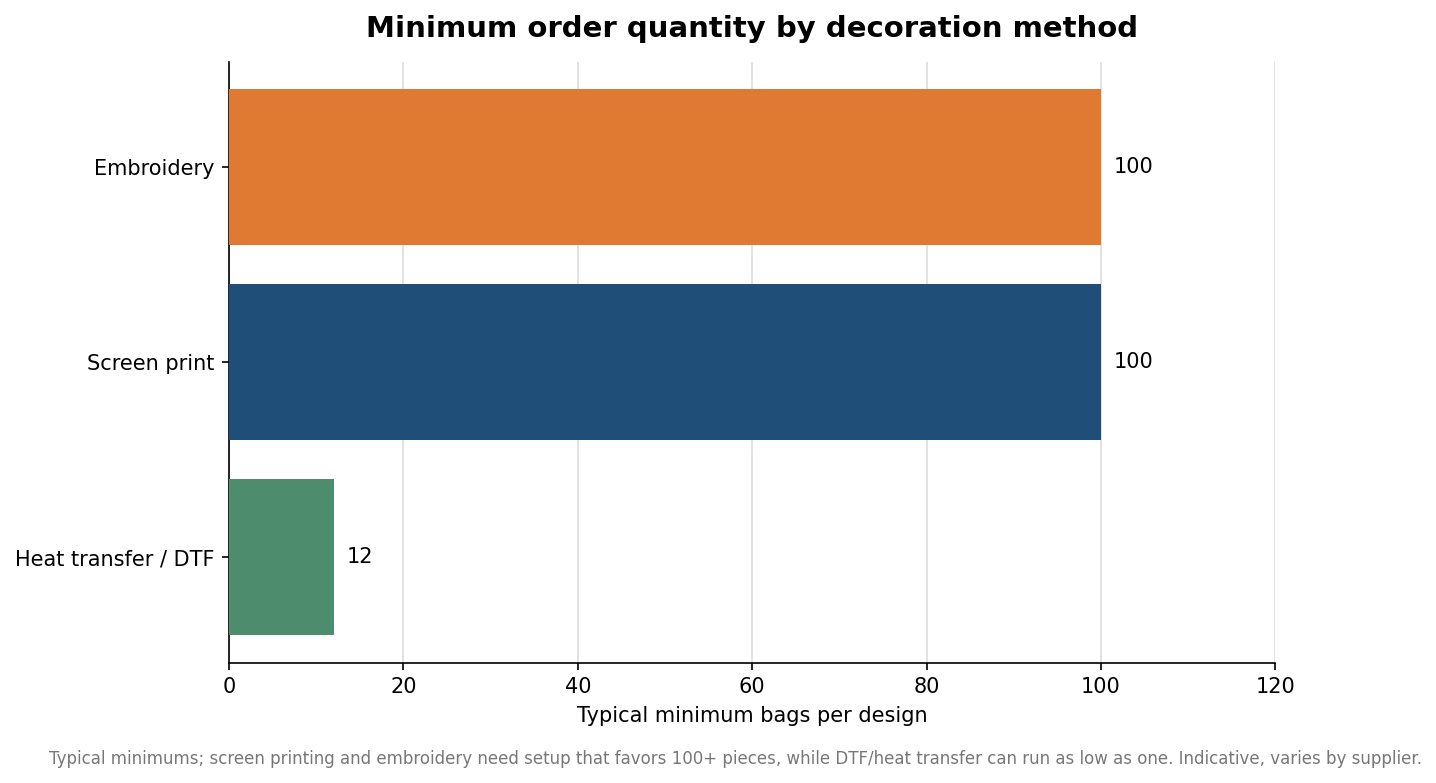
Screen printing pushes spot-color ink through a stencil, one screen per color. It is the most economical method at higher volumes for simple one- to three-color designs on flat, smooth panels, typically landing around $2 to $5 per piece. The catch is setup: every color needs its own screen, so minimums usually start near 100 pieces per design to justify the labor. On coated nylon or polyester, the shop needs inks formulated to bond — plastisol with an adhesion additive — or the print can crack and flake where the bag flexes. Screen printing is the wrong tool for photo-real logos, many-color crests, or short runs, but for a two-color team name across a large flat panel at volume, nothing beats its per-unit price.
Heat transfer and DTF: full color, low minimums, watch the edges
When you need a detailed, multicolor crest or a photographic mark, heat-applied transfers — especially DTF (direct-to-film) — reproduce complex images with no per-color setup. That makes them the economical choice for small orders, sometimes as few as one bag, and for artwork with gradients or many colors, usually around $2 to $5 per piece. The trade-off is long-term durability: a transfer sits on top of the fabric rather than penetrating it, so over years of abrasion and flexing it can lift or crack at the edges sooner than stitches would. Application discipline matters here more than with any other method — correct temperature, pressure, and dwell time, plus quality film, are the difference between a transfer that lasts several seasons and one that peels in one.
Worth a brief mention: full-dye sublimation, which infuses color permanently into the fabric, produces the most vivid all-over graphics but only works on light-colored polyester and is done on the panels before the bag is sewn, not applied to a finished bag. It is a cut-and-sew decision made at the manufacturing stage, not a decoration you add to a blank bag later.
Match the method to your order
The decision usually falls out of two questions: how many bags, and how complex is the logo. If you are ordering 100 or more bags with a bold one- to four-color logo and you want it crisp after a hard season, embroidery is the safe default. If you are printing a simple one- or two-color design on a large flat panel at high volume and price is the priority, screen printing wins on cost. If you need a detailed, full-color crest, or you are ordering only a handful of bags, DTF or heat transfer is the practical choice. Plenty of teams combine methods — an embroidered primary logo on the main panel, with a transferred player name and number on the end pocket — to get durability where it shows and flexibility where it changes year to year.
Whatever you choose, build a little time and one test into the schedule. Digitizing or art setup adds a day or two; decoration itself adds roughly one to three weeks after art approval, on top of blank-bag production. Approve a digital proof of placement and size, and if the order is large, pay for a single decorated sample before committing the full run. A ten-dollar sample is cheap insurance against a hundred bags with the logo an inch too low.
Leave a Reply